+44 203 507 0033
What is RAG (retrieval-augmented generation) and why does it matter?

Ask a large language model a question outside its training data, and it has two options: admit it does not know, or make something up that sounds confident anyway. Research from Gartner suggests that roughly half of enterprise AI responses contain fabricated information when the model is pulling from poorly governed data. RAG exists specifically to fix that
Rather than relying purely on what a model memorised during training, RAG lets it look something up first, then answer based on what it found. This guide explains what RAG actually is, how it works step by step, where it genuinely helps, and where its limitations still catch people out.
Key takeaways
|
What is RAG (retrieval-augmented generation)?
So what is RAG, in plain terms? Retrieval-augmented generation is a technique that gives a language model access to an external source of information at the moment it generates a response, rather than relying solely on what it learned during training.
Rag definition aside, the practical effect is simple: instead of an AI model guessing an answer from memory, it retrieves relevant documents, data, or passages first, then uses that retrieved material to generate a more accurate, grounded answer. Rag full form, retrieval-augmented generation, describes exactly that two-part process: retrieval, then augmented generation.
This matters because language models are trained on a fixed snapshot of data. Once training ends, that knowledge stops updating. Rag stands for a practical workaround to that limitation: rather than retraining the entire model every time something changes, you simply update the external knowledge source it retrieves from. The model itself stays the same. What it can answer accurately keeps expanding.
How does RAG work?
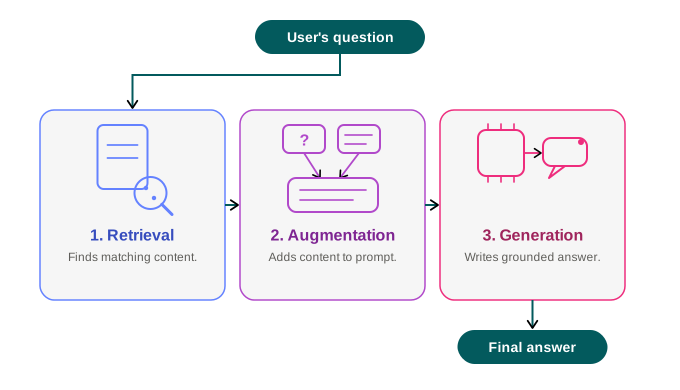
Step 1: Retrieval
Retrieval is where a RAG system searches an external knowledge source, a document library, a database, a set of internal company files, for content relevant to the user's question. This usually works through vector search: the question and the stored content are both converted into numerical representations called embeddings, and the system finds the stored content whose embedding is mathematically closest to the question's embedding.
This is different from a simple keyword search. Vector-based retrieval can find genuinely relevant content even when the wording in the question and the wording in the source document do not match exactly, which is what makes RAG systems feel like they understand intent rather than just matching text.
Step 2: Augmentation
Augmentation is the step that gives RAG its name. Once the system retrieves the most relevant pieces of content, it inserts them directly into the prompt sent to the language model, alongside the user's original question. The model now has both the question and the supporting material it needs to answer accurately, in the same context window.
This step is where careful engineering matters most. Retrieving too much content overwhelms the model's context window and adds noise. Retrieving too little leaves gaps the model will fill with guesswork. Getting the balance right is one of the most common challenges in building a genuinely reliable RAG system.
Step 3: Generation
Generation is the final step, where the language model produces its answer using both its own internal knowledge and the retrieved content it was just given. Because the model has been handed specific, relevant source material, its answer is grounded in something verifiable rather than reconstructed purely from memory.
Many RAG systems also return the retrieved sources alongside the answer, letting users see exactly where the information came from. That transparency is a genuine advantage over a standard language model response, which offers no way to verify where a claim originated.
Why does RAG matter?
Why does RAG matter, beyond the technical mechanics? Three reasons consistently come up in practice.
The first is accuracy. Hallucinations, confidently stated, completely fabricated answers, are one of the most persistent problems with large language models. Grounding a response in retrieved, verifiable content meaningfully reduces how often a model invents something that sounds plausible but is not true.
The second is currency. A language model's training data has a cutoff date, after which it knows nothing new by default. RAG sidesteps this entirely: as long as the external knowledge source is kept up to date, the model can answer questions about information that did not exist when it was trained.
The third is cost. Retraining or fine-tuning a large language model every time information changes is expensive and slow. Updating a retrieval database is comparatively trivial, often as simple as adding or replacing a document. This is precisely why RAG has become the default approach for businesses that want an AI system to answer accurately about their own proprietary information, policies, or product details, without retraining anything every time something changes.
RAG vs fine-tuning vs a plain LLM
Understanding RAG vs LLM and RAG vs fine-tuning questions matters because these are not competing options solving the same problem. They solve different problems, and the strongest AI systems often combine more than one.
A plain LLM relies entirely on what it learned during training. It is fast and requires no extra infrastructure, but it cannot access anything outside its training data, and it has no mechanism to verify what it says.
Fine-tuning adjusts a model's internal parameters using additional training examples, teaching it a particular style, format, or specialised behaviour. It is well suited to changing how a model responds, but poorly suited to keeping it updated with fast-changing facts, since every update requires retraining.
RAG LLM systems take a different approach entirely: rather than changing the model, they change what information it has access to at the moment it answers. This makes RAG the better fit whenever the priority is factual accuracy and up-to-date information, rather than changing the model's underlying behaviour or tone.
| Approach | How it works | Best for |
|---|---|---|
| Plain LLM | Answers purely from training data | Fast, general-purpose answers |
| Fine-tuning | Retrains the model on additional examples | Changing tone, style, or specialised behaviour |
| RAG | Retrieves external content at answer time | Factual accuracy, current and proprietary information |
Common RAG use cases
RAG use cases span far beyond chatbots, though that is usually where people encounter it first.
- Customer support: a rag chatbot can answer detailed product questions by retrieving information directly from a company's documentation, rather than relying on a generic, pre-trained understanding of the product.
- Internal knowledge search: employees can ask natural-language questions and get answers grounded in a company's actual policies, contracts, or internal documentation, rather than searching through folders manually.
- Legal and compliance research: retrieving from a specific, current set of regulations or case law gives far more reliable answers than a model's general training data, which may be outdated or incomplete on niche legal questions.
- Healthcare and clinical reference: retrieving from up-to-date clinical guidelines reduces the risk of a model relying on outdated treatment information from its training data.
- Technical documentation assistants: engineers can query a RAG system grounded in a codebase's actual documentation rather than a model's general, sometimes inaccurate, understanding of a specific library or API.
Does ChatGPT use RAG? In practice, yes, in certain forms. When ChatGPT or similar assistants browse the web or reference uploaded documents, they are using a version of retrieval augmentation, retrieving relevant content and incorporating it into the response, even if the underlying implementation differs from a custom-built enterprise RAG system.
Naive RAG vs advanced RAG
Not all RAG implementations are built the same way, and the differences matter more than the shared name suggests.
Naive RAG describes the simplest version: retrieve the most similar documents to a query, insert them into the prompt, generate an answer. It is straightforward to build and works reasonably well for simple use cases, but it struggles when a question requires combining information from multiple sources, or when the most similar document is not actually the most useful one.
More advanced RAG framework approaches address these gaps directly. Techniques include re-ranking retrieved results by relevance before they reach the model, breaking complex questions into smaller sub-questions handled separately, and combining retrieval with structured data sources rather than relying purely on unstructured documents. These additions add complexity, but they meaningfully improve accuracy for harder, more ambiguous questions, which is exactly where naive RAG tends to fall short.
Limitations and challenges of RAG
Rag limitations deserve honest attention, since most of the disappointment with RAG systems in practice comes from underestimating them.
Retrieval quality is the most common failure point. If the system retrieves the wrong document, or an irrelevant section of the right one, the model generates a confident answer based on bad information, which can be harder to catch than a model simply admitting it does not know.
Latency is a real, practical cost. Retrieval adds an extra step before generation even begins, which can noticeably slow down response times compared with a plain language model, particularly for complex queries requiring multiple retrieval steps.
Data quality dependency is the least visible but most important limitation. A RAG system is only ever as good as the knowledge source it retrieves from. Outdated, poorly organised, or contradictory source documents produce outdated, poorly grounded, or contradictory answers, no matter how capable the underlying language model is.
When should a business consider RAG?
When to use RAG comes down to a fairly simple test: does your use case depend on accurate, current, or proprietary information that a general-purpose model would not already know?
Rag solutions tend to make the most sense when a business has a substantial body of internal documentation, policies, or product information that customers or staff regularly need answers from. They make less sense for simple, general-knowledge tasks where a plain language model already performs well, since the added retrieval infrastructure introduces cost and complexity without a corresponding benefit.
RAG tools have matured considerably, and building a basic implementation is more accessible than it was even a year ago. What still separates a genuinely useful RAG system from a disappointing one is less about the tools themselves and more about how well the underlying knowledge source is structured, maintained, and kept current.
How Geeks can help with RAG implementation
If you are exploring whether RAG is the right fit for your business, the honest answer is that it depends entirely on the shape of your data and what you actually need an AI system to answer accurately.
As a retrieval augmented generation implementation partner, Geeks works with businesses to assess whether RAG, fine-tuning, or a simpler approach genuinely fits their use case, rather than defaulting to the most talked-about option. A RAG implementation partner that starts with your actual data and use case, rather than the technology itself, tends to produce far more reliable results.
If you want a clearer picture of where this fits for your business specifically, an AI opportunity discovery workshop is a useful, low-commitment way to find out before building anything.