+44 203 507 0033
AI and cross-cultural trust: what global expansion needs

AI has quietly solved one of global business's oldest problems, the language barrier. Draft a message in English, run it through a model, and a partner in Shenzhen or Ho Chi Minh City can read it in their own language within seconds. What AI hasn't solved, and might not solve for a long time yet, is trust.
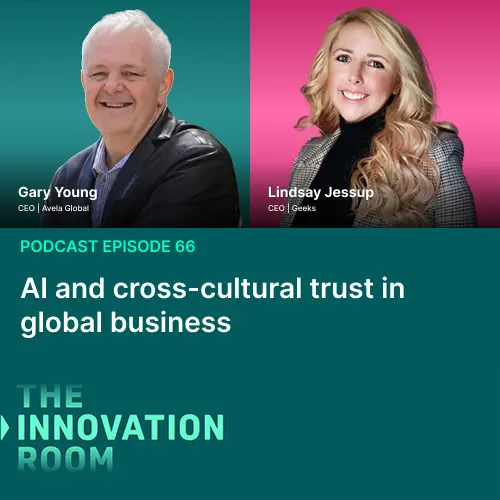
That's the thread running through the latest episode of Geeks' Innovation Room podcast, where our CEO, Lindsay Jessup sat down with Gary Young, CEO of Avela Corporation. Gary has spent 24 years navigating global manufacturing and sourcing on behalf of US and Dubai-based clients, working across China, Vietnam, India, and beyond. His read on AI culture across these markets, and exactly where the technology earns its place in high-stakes negotiations, is worth hearing in full.
| 🎧 Listen now: Episode 66, “AI and cross-cultural trust in global business”, featuring Gary Young, CEO of Avela Corporation, and Geeks CEO Lindsay Jessup. Listen to the full episode → |
Why AI hasn't solved cross-cultural trust
Ask Gary where AI stops being useful in a negotiation, and his answer is blunt: at the handshake. AI can organise your thinking, surface both sides' priorities, and stop you walking into a meeting underprepared. It cannot make the personal connection that actually closes a deal.
Real-time translation is a good example of the gap between what's technically possible and what's culturally trusted. The tools to listen to a room and translate it live already exist. Adoption hasn't caught up. In Gary's experience, people still don't fully trust being translated in the moment, and pulling out a phone mid-conversation can read as a small breach of respect in cultures where formality matters. Where the tools genuinely help is earlier, in the preparation, staff drafting a message in a second language and asking AI a simple question: does this make sense? That single check catches a misunderstanding before it reaches the table, not during it.
This is where Gary's phrase “feet on the ground” comes in. His staff in China speak Chinese to Chinese, catching nuances and red flags that neither a human translator nor an AI tool would reliably surface, because those signals come from shared culture and years of built rapport, not just shared language. AI can prepare the ground. It can't yet replace the person standing on it.
Where AI is already earning its place in global deal-making
Long before Gary or a client is in the room, his team is already deep into AI-assisted preparation. Three areas stand out, and none of them involve AI making the decision itself.
Negotiation prep, not negotiation
Before any deal, Gary's team gathers data: compliance checks, factory audits, background research, multiple perspectives on what both sides actually need. AI in negotiation, used this way, turns what used to be days of research into hours, and it means the team walks into a room with real confidence rather than guesswork.
Second-language clarity, not real-time translation
Most of the AI use inside Avela happens staff-to-staff, long before anyone senior is involved. Someone drafts a report in their second language, runs it past an AI tool, and gets a straightforward answer to a straightforward question. Gary says that single habit has quietly cut out the kind of miscommunication that used to derail deals months down the line.
Faster reporting across time zones
AI is also closing what Gary calls the minute-to-a-week problem: a one-minute delay can become a day, a day can become a week, and a week can mean missing a shipping deadline entirely. Clearer, AI-assisted reporting means decisions that used to wait for a factory owner to return from a conference in Hong Kong can now happen the same day, wherever they happen to be.
The new fourth column
For most of Gary's career, sourcing decisions came down to what he calls a three-legged stool: price, quality, and delivery. The rule of thumb was you could usually have two of the three, never all three at once. That's changed.
“Now I'm starting to think that instead of calling it a stool, you call it four columns. Because if a company isn't keeping up with technology, what else aren't they keeping up with?”
— Gary Young, CEO, Avela Corporation
A partner's willingness to invest in technology, in other words, has become as telling as their pricing or their delivery record. It's a live signal of whether they're keeping pace with their own supply chain and their own compliance, and whether they'll still be a reliable partner in five years' time. Gary now factors it into how he reads a factory before he ever discusses price.
The death of distance
One of the more striking threads in the conversation is what Gary describes as a shift away from making everything in China and shipping it globally, toward something more decentralised and, in places, more local.
He points to 3D printing as a case study in miniature. On the International Space Station, astronauts don't wait weeks for a replacement part, they send a file and print one on board. Gary has seen the same shift happening in Chinese factories the size of football pitches, printing parts in stainless steel and bronze for the EV industry rather than casting them, because the industry now moves faster than a mould can be made.
That logic is starting to apply at a national level too. Gary described a long-standing client who spent 15 years refining a single factory and now treats it almost like a blueprint, a process he can pick up and place in a new country, complete with the experience behind it, rather than rebuild from scratch. One manufacturer he works with expanded from China into Cambodia and then Egypt, partly to serve European markets more efficiently and partly, in Gary's words, because no country wants all its eggs in one basket.
There's a national pride element here too, not just efficiency. Gary described being approached by a businessman in Dubai who offered to fly a Chinese manufacturer out to Saudi Arabia, first class, specifically because the country wants manufacturing capability of its own rather than simply being a buyer. Decentralised manufacturing, in that sense, isn't only a supply chain trend. It's a statement of ambition.
Gary doesn't expect this to happen overnight. Small-scale decentralisation is already happening, by his account. Reaching true industrial scale could take another two decades. But the direction of travel is clear, and it's technology, as much as economics, that's driving it.
What this means if you're expanding internationally
None of this is specific to sourcing or manufacturing. The same pattern applies to any business building relationships, teams, or supply chains across borders, and it's worth translating into a few practical habits.
- Use AI to prepare, not to replace the person in the room. It sharpens your homework and catches translation issues before they reach a client, but the relationship still needs a human on the ground.
- Treat a partner's AI adoption as part of your due diligence. If a supplier isn't investing in their own technology, it's often an early signal of wider issues in their supply chain or compliance.
- Watch for decentralisation in your own supply chain. Local, on-demand production is moving from a niche capability to a genuine alternative to shipping everything from a single hub.
- Build in the time zone advantage. Faster, AI-assisted reporting closes the gap between a decision made in one country and action taken in another, but only if your team on the ground is empowered to use it.
- Invest in feet on the ground before you invest in tooling. AI supports the people who understand a market's culture and language. It doesn't substitute for them.
This article covers the highlights, but the full episode goes further: how robotics helped one factory scale from 200 employees to producing four times as much, why AI adoption speed varies so much between China, Vietnam, India, and Cambodia, and Gary's own timeline for how long full-scale decentralisation could realistically take.
Listen to Episode 66, “AI and cross-cultural trust in global business,” on The Innovation Room →